Redesigning PagerDuty's web experience for AI-informed buyers,using behavioral insights and
experimentation to increase trial sign-ups by 73%.
experimentation to increase trial sign-ups by 73%.
For years, websites were designed around exploration. People arrived with questions, navigated through pages, compared features, and gradually built confidence before making a decision.
Today, that journey is changing.


AI assistants increasingly help buyers discover, compare, and narrow down products before they ever visit a website.
By the time someone lands on a homepage, they're often looking for confirmation rather than introduction.
This shift challenged many traditional web design patterns—and became the foundation of the redesign.
PagerDuty's existing website was also built for the traditional buying journey, and we had to adapt it for today's world.
Traditional web journeys no longer matched buyer behavior → AI shifted product discovery away from websites, making exploration-focused experiences less effective.
Generic experiences created uncertainty → The same messaging and product story failed to address different user goals and intent.
Product value took too long to validate → Buyers needed authentic product experiences and customer evidence before committing to a trial.
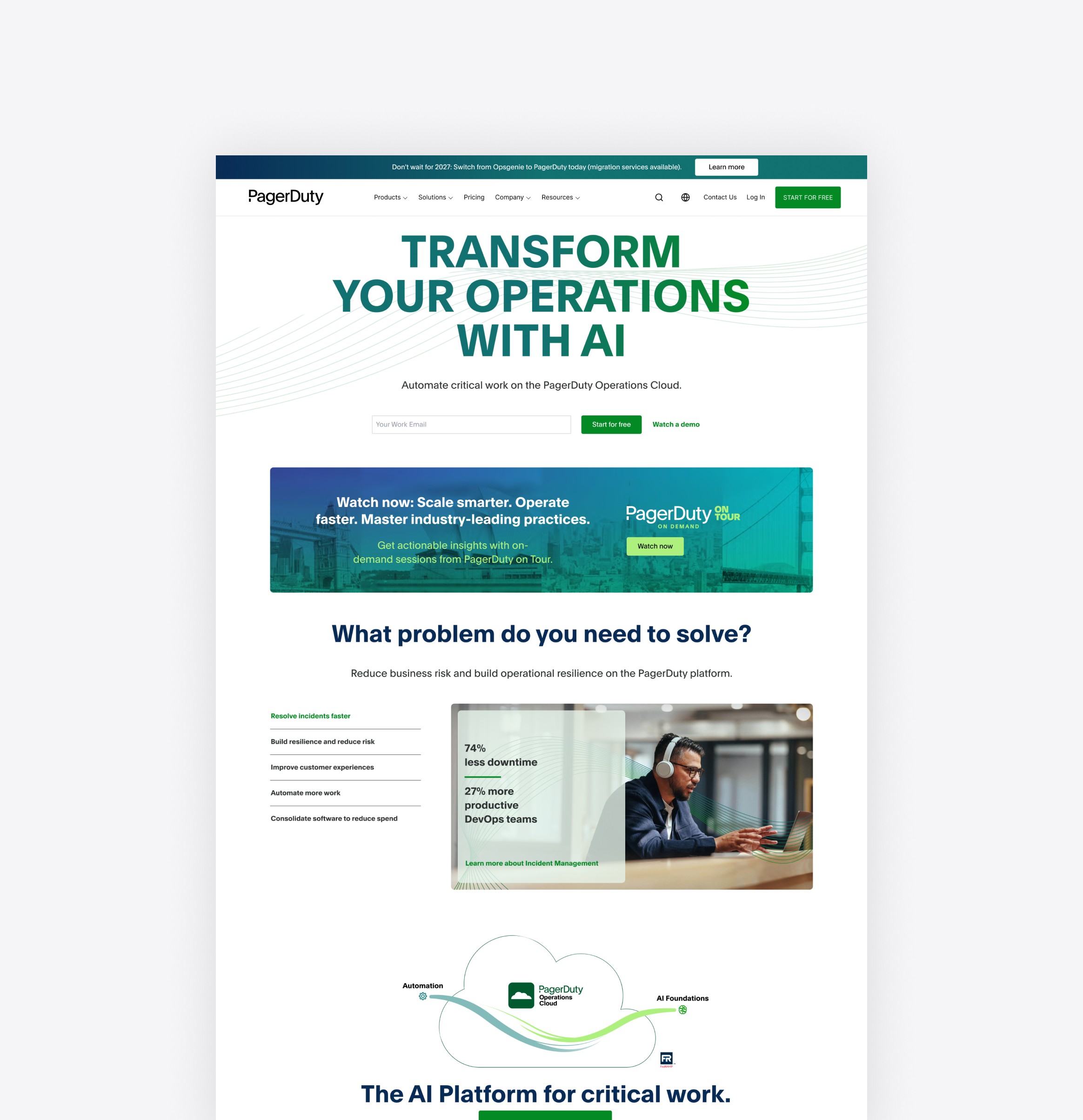

The goal wasn't to redesign pages visually. It was to reshape the entire experience for a new decision-making process in the age of AI.
Design for AI-informed buyers → Shift the website from introducing products to validating decisions.
Personalize around user intent → Help different audiences immediately recognize relevant value.
Build trust through authentic experiences → Combine real product interactions with customer proof to accelerate confidence.


Validated
Statistically significant evidence
Directional
Positive movement, additional validation needed.
Observed
Detected repeating behavioral patterns without significant statistical validation.
Some experiments produced statistically significant wins, while others revealed directional or behavioral signals. Together, they informed the redesign and helped identify patterns that extended beyond individual pages or components.
Can messaging tailored to specific user groups and industries increase engagement?


+16%
enterprise engagement
Observed
Behavioral Signal
Enterprise visitors engaged more when the homepage reflected their context.
AI-Era Design Insight
As AI helps buyers research products before visiting a website, they arrive with stronger intent and expect immediate confirmation that they're in the right place.
Does showing the actual product create more engagement than stock imagery or a demo video?

+16%
video CTA clicks
Directional
Behavioral Signal
Showing the actual product generated more interest than stock imagery.
AI-Era Design Insight
As AI makes marketing claims easier to generate, authentic product experiences become a stronger signal of trust and credibility.

Can the value proposition adapt to the visitor instead of staying generic?

+45%
trial submissions
Directional
Behavioral Signal
Generic messaging explains. Relevant messaging creates stronger intent.
AI-Era Design Insight
High-intent buyers don't need generic value propositions. They look for messaging that validates what they already believe the product can do.

What happens when we remove competing content?

+19%
trial submissions
Validated
Behavioral Signal
Reducing cognitive load creates a clearer path to conversion.
AI-Era Design Insight
When buyers arrive with greater context, unnecessary explanation becomes friction. The experience should help them act, not educate them from the beginning.

Can clearer pricing information and language encourage buyers make decisions faster?

+90%
contact sales conversion
Validated
Behavioral Signal
Making savings visible encouraged more buyers for sales conversation.
AI-Era Design Insight
The sign-up experience was redesigned to simplify progression, improve clarity, and reinforce confidence throughout the onboarding flow. Rather than introducing new interactions, the work focused on removing friction between purchase intent and action.

Can clearer language encourage enterprise buyers to take action?

+44%
enterprise CTA clicks
Directional
Behavioral Signal
Reducing ambiguity helps users commit to the next step.
AI-Era Design Insight
High-intent buyers scan for clarity rather than persuasion. Clear language reduces uncertainty and helps them confidently take the next step.

Design Decisions
Across these experiments, three consistent patterns emerged. Pointing toward a broader shift in how high-intent buyers evaluate software. These patterns became the foundation of the design decisions.
Recognition before explanation
🔻 Buyers wanted to immediately identify themselves instead of interpreting generic messaging.
Validation over discovery
🔻 Authentic product experiences and customer proof built confidence faster than conceptual marketing.
Confidence before commitment
🔻 Once uncertainty was reduced, removing friction from sign-up became more valuable than adding information.
The redesign introduced audience-specific experiences that helped buyers immediately recognize themselves within the product.

The homepage shifted from a one-size-fits-all introduction to audience-specific journeys. Rather than asking visitors to interpret how PagerDuty applied to them, the experience immediately reflected their context through personalized messaging, relevant product examples, and AI-assisted workflows.
Instead of describing AI capabilities through marketing copy alone, the redesigned experience allowed buyers to explore individual AI agents through authentic product experiences.

Instead of presenting AI as a single capability, the redesigned experience helped buyers explore individual agents through authentic product interactions, measurable customer outcomes, and supporting case studies that reinforced trust throughout evaluation.
The redesigned onboarding balanced clarity, trust, and value communication to help visitors commit with confidence.

The final sign-up experience combined learnings from multiple experiments into a simpler, higher-confidence onboarding flow. Rather than relying on a single optimization, the redesign balanced value communication, trust signals, and onboarding clarity to help visitors move confidently toward trial.
The resulting design patterns improved conversion performance across multiple initiatives, including a 73% increase in trial sign-ups, while creating a scalable foundation for future AI-era experiences.
Key Takeaways


